
App development for a share of revenue
We develop your app or platform for a reduced payment plus a percentage of the revenue it earns, up to an agreed cap. We take a revenue share only where the business already earns, and always alongside payment rather than instead of it. You spend less upfront, and we are motivated by the same number you are: sales.
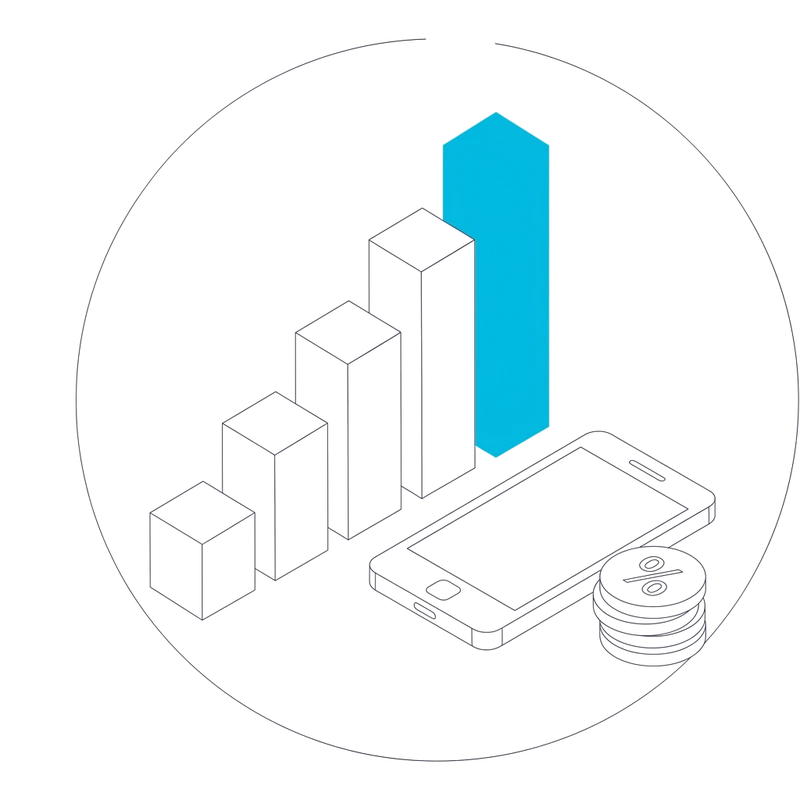
When revenue share works
Revenue share fits products sold through channels that already exist and earn. It does not fit pre-revenue ideas, and it never replaces paying for the work.
- You run a business with customers and revenue, and the new product will be sold to them
- The monetization model is clear: subscriptions, transactions, paid features or fees
- You have distribution: an audience, a sales team, partners or marketplace presence
- Revenue from the product can be measured separately from the rest of the business
- You can pay for part of the work now and want to lower the upfront cost without giving away equity
How the model is structured
Paid development at a reduced rate
You pay for development at a rate below our standard one, and part of the payment is always cash. The difference is our investment in the product, recovered through revenue share.
Share of revenue
We receive an agreed percentage of the revenue the product generates. What counts as revenue, gross or net, is defined precisely in the agreement.
Cap and term
Payments stop when an agreed total is reached or the term ends, whichever comes first. You always know the maximum the deal can cost.
When revenue share does not work
- The product has no customers or sales channel yet
- Revenue share instead of any payment for the work
- Revenue from the product cannot be measured separately or shown to us

What the terms depend on
There is no standard percentage. The terms are a balance of three levers: how much the rate is reduced, what share of revenue we receive and where the cap sits. A deeper discount means a higher share or a higher cap; a shorter term usually means a higher share. We model a few scenarios with you based on your sales forecast, so both sides see what the deal looks like if the product sells slowly, as planned or better than planned.
- The size of the discount on development
- Your monetization model, pricing and sales forecast
- The strength of existing distribution
- The length of the term and the payout cap
- Whether we also support and develop the product after launch

Transparent reporting
A revenue share only works when both sides trust the numbers. The agreement defines what revenue is included, what is deducted, such as app store fees, taxes or refunds, and how often payments are made. We agree on the source of truth, for example payment provider or store reports, and read-only access to it, so reporting takes minutes instead of turning into a monthly negotiation.
- A precise definition of revenue in the agreement
- Regular reports from the payment provider, store or accounting system
- Read-only access to the relevant data
- A fixed payment schedule
Risks, and how we remove them
Both sides take a risk: you commit a share of future revenue, we accept a lower rate on the hope of sales. The main risks are known in advance and covered in the agreement. You keep full ownership of the product and the code, and the partnership can be closed early by paying out an agreed amount if the business outgrows the arrangement.
- Cap and term limit what you can ever pay
- Early buyout option at a price agreed upfront
- IP and code owned by your company throughout
- Rules for pricing changes, bundling or selling the product
How a revenue share project runs
Business review
We look at your current business, customers, channels and the monetization model of the new product.
Scope and estimate
We define the first release and estimate it at our standard rate, so the size of our investment is clear.
Deal modelling
We propose the discount, revenue share, cap and term, and model them against your sales forecast.
Written agreement
Revenue definition, reporting, payments, buyout and exit rules are fixed in a written agreement.
Build and launch
We develop, test and release the product, and you bring it to your customers.
Reporting and payouts
Revenue is reported on the agreed schedule until the cap or the end of the term.
Variations of the model
Discount plus revenue share
The standard setup: reduced rate for the build, a capped share of revenue afterwards.
Revenue share with support
The share also covers ongoing support and small improvements after launch for the term of the deal.
Performance bonus
A regular contract with a bonus paid only if the product reaches agreed revenue targets.
Reviews
We treat each client and his project with love.

Revol team continues to streamline the client’s development capabilities through their high-quality work and reliable support. They communicate effectively and exhibit a strong understanding of the client’s needs and business.
Tomas

The work from Revol, have fully met expectations and satisfied the client. Their fresh approach and ability to remain available for support have been valuable assets. Customers can bring them on for a communicative, client-oriented team to achieve their goals with.
Andrey
Frequently asked questions
What percentage of revenue do you take?
It depends on the discount, the cap, the term and your sales forecast. We propose terms after reviewing the business and show them in scenarios, so you can compare the total cost with a regular contract.
Can you build it for revenue share only, with no payment?
No. We take a revenue share only where the business already earns, and always alongside payment rather than instead of it. Without a cash part the arrangement stops being sustainable long before the product has a chance to sell.
Is revenue share better than giving equity?
For a business that already sells and wants to keep its ownership, usually yes: the cost is limited by a cap and ends at a known point. For a pre-revenue startup, revenue share rarely works, because there is nothing to share for a long time.
Is it gross or net revenue?
That is defined in each agreement. Commonly the base excludes app store fees, taxes and refunds, but the exact definition depends on how the product is sold.
Can we end the revenue share early?
Yes. An early buyout amount or formula is agreed upfront, so you can close the arrangement, for example after a funding round or an acquisition.
What if the product earns less than expected?
Then we earn less, which is the risk we accept. You still own the product and the code, and the payments stop at the end of the term regardless of the total reached.
Who owns the app and the code?
Your company, fully. Revenue share gives us a right to part of the revenue for a limited time, not ownership of the product.
Tell us about your project
Describe the task in a few lines. Within one working day we reply with questions or a first view on scope and cost.
Prefer email or a call?
welcome@revolsource.com
+38 097 662 23 20
Revol Software OÜ, Tallinn, Estonia. Our team is distributed around the world.
Join our team
Send your CV to career@revolsource.com